Skin Bioelectrical Impedance: A Key Factor in Advanced Microcurrent Systems
A premium microcurrent device does more than deliver a low-level electrical signal to the skin. Its performance also depends on the electrical properties of the tissue and the interface between the treatment electrodes and the skin. Skin bioelectrical impedance is an important part of that equation because it helps explain why the same device setting may produce different electrical conditions from one treatment area or session to another.
Understanding impedance makes it easier to evaluate claims about automatic current adjustment, intelligent electrode systems, and personalized facial stimulation. It also clarifies an essential distinction: measuring an electrical property of the skin is not the same as measuring skin health, proving that a treatment is effective, or demonstrating that a device can deliver a perfectly uniform dose.
For advanced home beauty technology, the useful question is therefore not simply whether a device measures impedance. It is whether its electrical design, sensing method, and control strategy use that information meaningfully and safely.
What Skin Bioelectrical Impedance Actually Means
Electrical impedance describes how much a material or system opposes the flow of alternating electrical current. It is related to resistance, but the two terms are not interchangeable in every measurement context.
Resistance describes opposition to current that dissipates electrical energy. Impedance is the broader concept used when a system also exhibits frequency-dependent effects associated with capacitance and inductance. In biological tissues, membranes, extracellular fluids, intracellular fluids, and the electrode interface can all influence the measured response.
Skin is particularly interesting because it is not a uniform electrical barrier. The outer stratum corneum contains relatively little freely available water compared with deeper tissue, and its electrical properties can differ substantially from those of underlying skin. Hydration, sweat, temperature, the condition of the skin barrier, and the area and quality of electrode contact can all affect a measurement.
In a microcurrent application, the term skin bioelectrical impedance may refer to the electrical response of the skin-electrode interface or to a broader tissue pathway that includes skin and underlying structures. Those are not identical measurement targets. The exact interpretation depends on electrode configuration, signal frequency, sensor design, and the device's measurement protocol.
What Official Technical Evidence Can—and Cannot—Establish
Electrical impedance is an established concept in electrical engineering and biomedical measurement. Its interpretation follows the principles of circuit analysis and electrochemistry, while its application to living tissue requires attention to biological variability and measurement conditions.
For example, the U.S. Food and Drug Administration distinguishes general device safety and regulatory requirements from evidence supporting a particular medical or cosmetic performance claim. A regulatory clearance, where applicable, relates to a specific device, intended use, and regulatory pathway. It should not be interpreted as universal proof that every feature marketed under terms such as intelligent impedance sensing or adaptive microcurrent has been independently validated.
Similarly, technical literature on bioelectrical impedance analysis describes how measurements depend on frequency, electrode placement, tissue properties, and the measurement system. Research on whole-body or segmental bioimpedance can provide useful background about electrical behavior in biological tissues, but it cannot automatically validate a facial beauty device that uses different electrodes, frequencies, waveforms, and control logic.
For an advanced microcurrent system, the most informative evidence would identify the electrical quantity measured, the conditions under which it is measured, the device's response to different readings, and the tests used to verify that response. A claim that a product is impedance-aware is more meaningful when accompanied by a defined sensing method and reproducible validation than when it appears only in promotional language.
How Advanced Microcurrent Devices Measure or Analyze Impedance
Microcurrent systems use low-level electrical signals for cosmetic facial applications. Depending on their design, devices may deliver a preset waveform, offer selectable intensity levels, or incorporate sensing and control features. Not every microcurrent device measures impedance, and not every device that measures an electrical parameter uses it to adjust the treatment automatically.
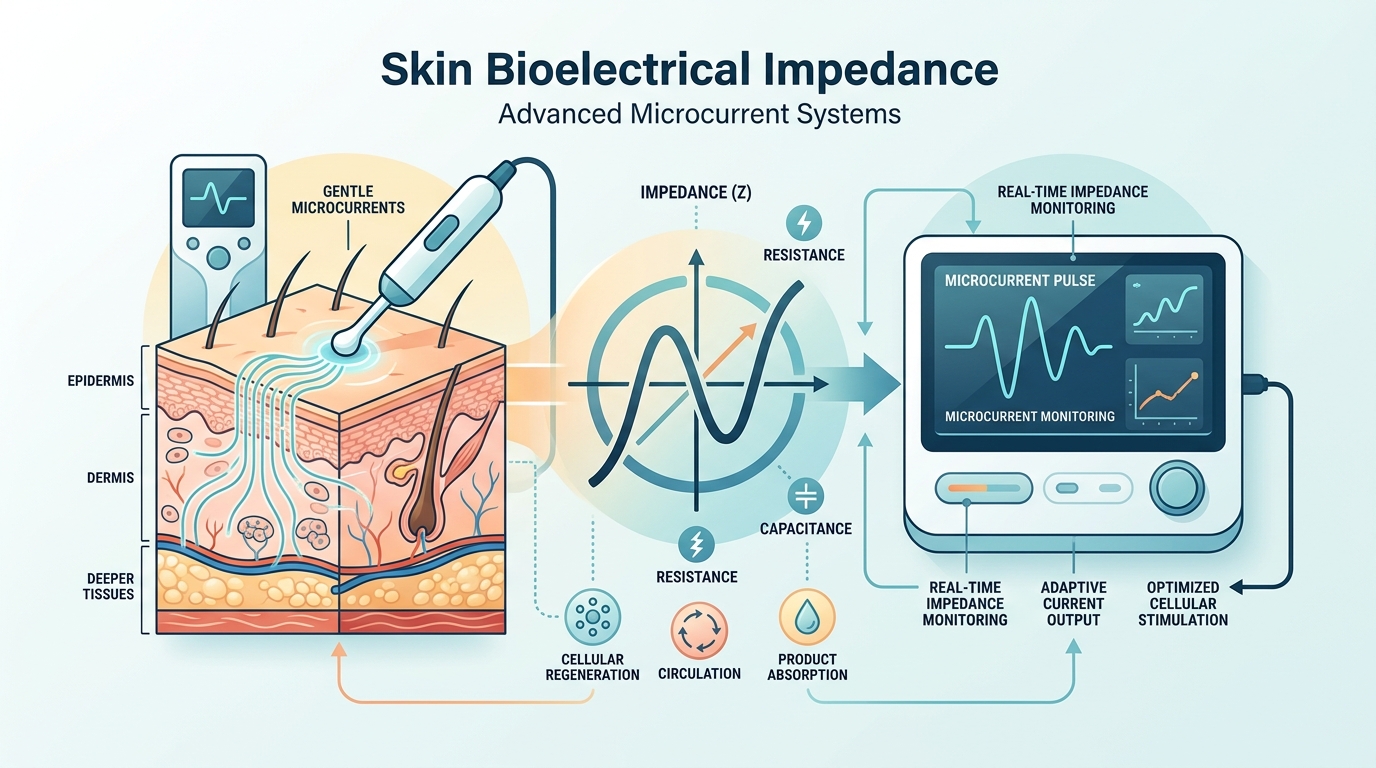
A typical impedance-measurement approach applies a known electrical stimulus and observes the resulting voltage or current. Under appropriate conditions, the relationship between these quantities can be used to estimate impedance. The measurement may use a separate sensing signal or a design that incorporates sensing into the treatment electronics.
For a simplified system, the magnitude of impedance can be expressed as:
|Z| = |V| / |I|
Here, |Z| represents impedance magnitude, |V| represents voltage magnitude, and |I| represents current magnitude. This relationship is useful for understanding the principle, but actual devices may need to account for waveform shape, phase, frequency, electrode polarization, circuit losses, and measurement noise. A simple voltage-to-current ratio does not, by itself, establish that a device has accurately isolated the skin's intrinsic properties.
1. Applying a controlled signal
The system applies a signal under defined electrical conditions. The signal used for sensing may differ from the therapeutic microcurrent waveform. Its amplitude, frequency, duration, and timing affect what can be measured and how much the measurement itself interacts with the electrode-tissue interface.
2. Observing the electrical response
Electronics measure the resulting voltage, current, or related signal characteristics. Depending on the circuit, the system may estimate impedance magnitude alone or obtain additional information about phase. The result is meaningful only in the context of the sensing method and its calibration.
3. Interpreting the reading
Processing software may compare the reading with a reference range, evaluate whether electrode contact is adequate, or estimate whether the electrical load has changed. Such processing can improve consistency when the underlying measurement is reliable and the interpretation has been validated for the device's intended conditions.
4. Using the result to control output
A closed-loop system may adjust an output parameter, restrict delivery, or prompt the user to reposition the electrodes. A different design may merely display a measurement or use it to identify a contact problem. These functions should not be treated as equivalent.
In particular, sensing does not guarantee that current distribution is uniform throughout the tissue. The result depends on electrode geometry, local anatomy, tissue conductivity, and the complete electrical path. Even a well-designed feedback system has limits to what it can infer from its sensors.
Why Impedance Matters for Consistent Facial Stimulation
Two treatment areas can respond differently to the same electrical settings because their surface conditions and underlying electrical pathways are not identical. This variability is one reason impedance is relevant to premium devices that aim to make stimulation more consistent.
Consider a facial electrode placed first on well-hydrated skin and then on a dry area with poorer contact. The electrical interface may differ between those situations. A device that monitors relevant electrical parameters could potentially identify a change and respond according to its design. A device without such sensing may rely entirely on fixed settings and the user's technique.
However, a change in impedance does not have a single universal interpretation. A higher reading might reflect a drier surface, altered electrode contact, a change in the electrical pathway, or a measurement artifact. It does not necessarily mean that the tissue needs more current. Likewise, a lower reading does not automatically mean that stronger stimulation is appropriate.
The practical value of impedance information lies in helping a properly designed system manage known variations—not in eliminating biological variability altogether.
The Variables That Influence a Skin Impedance Reading
This table highlights an important limitation: impedance is a context-dependent measurement. A reading taken on one day cannot necessarily be compared with a reading from another day unless the device, contact conditions, skin preparation, and measurement method are sufficiently consistent.
There is also a difference between repeatability and accuracy. A sensor that repeatedly reports similar numbers under similar conditions may be repeatable, but it may still be systematically inaccurate. Demonstrating accuracy requires suitable reference methods and validation, not simply a stable display.
How Impedance Sensing Can Support Personalized Microcurrent Delivery
Personalization in beauty technology can mean several different things. It may refer to a user-selected intensity, a program chosen for a facial area, an output automatically adjusted in response to sensor data, or a treatment plan informed by repeated measurements. These approaches offer different levels of adaptation.
For example, a system that detects poor electrode contact and asks the user to reposition the device can improve procedural consistency. A system that adjusts output within a validated operating range may offer a more direct form of electrical feedback. Neither feature, by itself, proves superior lifting, wrinkle reduction, or long-term skin improvement.
The strongest engineering approach is to connect each measurement to a defined action. If a sensor detects a condition associated with unreliable contact, the device might pause output or request repositioning. If a measurement falls outside its validated range, the system might restrict operation rather than increase intensity. The appropriate response depends on the product's actual design and safety testing.
Conversely, if a manufacturer cannot explain what its impedance sensor measures or how the result affects operation, the personalization claim deserves caution. A sensor may be present without providing a meaningful improvement to treatment control.
Impedance Is Not the Same as Current, Voltage, or Treatment Effectiveness
These terms describe different aspects of an electrical system. Understanding the distinction prevents a common misunderstanding in premium beauty-device marketing.
- Voltage describes the electrical potential difference that drives charge through a pathway.
- Current describes the rate at which electric charge flows.
- Impedance describes the opposition to alternating current, including frequency-dependent effects.
- Power describes the rate of energy transfer and depends on the relevant electrical quantities and waveform.
- Clinical effectiveness concerns whether a defined treatment produces a meaningful outcome supported by appropriate evidence.
For a simplified resistive load, Ohm's law relates voltage, current, and resistance. Real skin-electrode systems are more complex, so a single impedance value cannot fully describe the spatial distribution of current, the local electrical conditions, or the biological response.
It is therefore misleading to assume that lower impedance always produces better treatment, that higher impedance means a device should deliver more current, or that an automatic adjustment necessarily improves cosmetic results. The control strategy must be appropriate for the hardware and supported by testing.
Practical Checklist for Evaluating an Impedance-Aware Device
Use the following checklist to separate meaningful engineering capabilities from broad marketing language. It is intended to assess transparency and operating logic rather than rank products.
- Measurement definition: Does the documentation explain whether the device measures electrode contact, overall load impedance, or another electrical parameter?
- Measurement conditions: Are the relevant signal frequency, sensing approach, or calibration conditions described sufficiently to interpret the reading?
- Actual feedback: Does the measurement change device behavior, trigger a contact warning, restrict operation, or simply appear on a display?
- Defined control limits: Does the manufacturer explain how automatic adjustments remain within the device's intended operating range?
- Validation: Is there evidence that the sensor and control behavior were tested under realistic contact and skin-condition variations?
- Outcome evidence: Are claims about lifting, firmness, or wrinkle appearance supported by studies of the actual device and treatment protocol?
- Instructions: Are electrode placement, conductive-medium requirements, session duration, and cleaning procedures clearly specified?
- Safety information: Are contraindications, warnings, and instructions for abnormal sensations or skin reactions readily available?
- Consistent technique: Can you follow the recommended preparation and electrode-contact method without improvising to obtain a preferred reading?
If a product provides clear measurement documentation but limited clinical evidence, it may still have an interesting engineering design; its cosmetic benefits simply remain less certain. If a product offers clinical outcome evidence but does not measure impedance, it may still be effective for its studied use. Impedance sensing is one potential design feature, not a universal requirement for every successful microcurrent system.
Safety, Contraindications, and the Limits of Automatic Adjustment
Electrical feedback can help a device respond to certain changes in the load it encounters, but it cannot necessarily identify the cause of those changes. It cannot independently determine whether a user has an unrecognized medical contraindication, whether irritated skin should be treated, or whether a particular treatment is suitable for an individual.
Automatic control also has technical limits. Sensors have finite resolution, measurement noise can affect readings, and changes in electrode contact can occur during movement. A controller may react to an unexpected reading, but the quality of that reaction depends on the control algorithm, the safeguards built into the system, and the conditions under which the design was tested.
Never increase intensity beyond the manufacturer's instructions to compensate for a perceived lack of effect. Do not continue simply because the device reports an acceptable electrical condition if the treatment causes pain, burning, persistent redness, or unusual discomfort. Stop using the device and follow the manufacturer's guidance; seek medical advice when symptoms are significant or persist.
People with implanted electronic devices, certain medical conditions, compromised skin, or other circumstances covered by a product's contraindications should not assume that adaptive sensing makes the device appropriate for them. The presence of a sensor does not establish individual medical suitability.
Where Impedance-Based Personalization Has Clear Limits
Impedance sensing is most directly relevant to understanding electrical conditions at the device-tissue interface and, where the measurement method supports it, aspects of the broader electrical pathway. Its ability to predict cosmetic outcomes is much less direct.
Skin appearance depends on multiple interacting factors, including age, baseline skin condition, environmental exposure, skincare practices, facial anatomy, and the natural variability of biological tissue. An impedance measurement cannot isolate all these influences or determine how much a person will benefit from a microcurrent treatment.
There is also an important distinction between short-term appearance and durable change. A temporary difference in facial appearance after a treatment does not establish a lasting structural effect. To support claims about sustained improvement, studies need suitable outcome measures, a defined follow-up period, and methods that distinguish treatment effects from ordinary variation.
For consumers interested primarily in visible results, a device with an elaborate sensor suite but no credible outcome data may be less informative than a simpler system supported by well-designed studies. Conversely, for users and engineers focused on consistent electrical delivery, documented impedance monitoring may be valuable even when it does not directly predict the cosmetic outcome.
The appropriate interpretation depends on the question being asked. Electrical engineering evidence addresses how a device measures and controls its output. Clinical evidence addresses whether that output, used as intended, produces a meaningful benefit. Neither should be treated as a substitute for the other.
Frequently Asked Questions
1. What is skin bioelectrical impedance in simple terms?
It is a measure of how a skin-related electrical pathway opposes alternating current. The reading can be influenced by skin properties, electrode contact, signal frequency, and the measurement circuit. Its exact meaning depends on the method used.
2. Do all premium microcurrent devices measure skin impedance?
No. Some devices use preset electrical outputs, while others include contact monitoring or more advanced sensing and feedback functions. A premium price or an advanced-sounding product description does not establish that impedance is measured.
3. Does lower skin impedance mean a better microcurrent treatment?
Not necessarily. Lower impedance may change the electrical conditions of the system, but it does not automatically indicate better stimulation, safer operation, or improved cosmetic results. The significance of a reading depends on the device design and validated operating limits.
4. Can an impedance sensor tell whether my skin is hydrated?
Electrical properties can be influenced by hydration, but a general impedance reading is not automatically a validated skin-hydration measurement. A device would need an appropriate measurement method and supporting validation before its reading could be interpreted as a reliable hydration estimate.
5. Does automatic impedance adjustment make a device safer?
It may support specific safety or contact-control functions if those functions are properly designed and tested. However, impedance adjustment alone cannot guarantee safety, identify every contraindication, or eliminate risks associated with incorrect use. Follow the product's instructions and warnings.
6. Can impedance measurements predict lifting or wrinkle reduction?
Not on their own. Impedance characterizes electrical behavior, whereas lifting and wrinkle-related outcomes require appropriate cosmetic or clinical outcome measures. Predictive claims need evidence connecting the measurement to those outcomes for the actual device and treatment protocol.
7. Why might the same device produce different readings on different days?
Surface hydration, sweating, temperature, conductive-medium application, electrode pressure, placement, and skin condition may change. Sensor calibration and measurement variability can also contribute. Consistent preparation and technique help make comparisons more meaningful.
8. Is a displayed impedance number proof that a device is technologically advanced?
No. A numerical reading is useful only when the measured quantity is defined, the measurement is sufficiently reliable, and the information serves a meaningful function. Documentation of the sensing method, feedback logic, and validation is more informative than a display alone.
9. Should I choose a device with impedance sensing over one without it?
That depends on your priorities. If contact monitoring and adaptive control matter to you, look for documented, validated functions. If your main concern is visible cosmetic improvement, prioritize evidence for the specific treatment outcome, appropriate safety information, and a usable protocol. Neither device category is automatically superior in every respect.
Conclusion: Evaluate the Measurement, the Control System, and the Outcome Separately
Skin bioelectrical impedance provides a useful technical framework for understanding how a premium microcurrent device interacts electrically with the skin. Surface hydration, electrode contact, tissue properties, frequency, and circuit design all influence the conditions under which a signal is delivered. Measuring those conditions can support better contact monitoring and more informed control strategies when the sensing system is properly engineered and validated.
The key limitation is that impedance is not a universal indicator of skin quality or treatment success. A measurement cannot independently establish that the skin is healthy, that stimulation is optimally distributed, or that a cosmetic result will occur. Those conclusions require different forms of evidence.
For a technically informed assessment, examine three layers separately: what the device actually measures, what its electronics do with that measurement, and what independent or device-specific evidence supports its intended benefits. If the first two are documented but the third is not, the engineering feature may be credible while the cosmetic claim remains uncertain. If clinical evidence is available, evaluate whether it applies to the same device, settings, and intended use.
This distinction is central to understanding advanced beauty electronics. Meaningful personalization does not come from a sensor label alone. It comes from reliable measurement, a defensible control strategy, appropriate safety limits, and evidence that connects the complete system to the outcome it claims to deliver.


Comments
Post a Comment